
Ecological Interactions between Wild & Hatchery Salmon
May 4–7, 2010 • Hilton Hotel • Portland, Oregon
A conference with ‘one great, common heart’
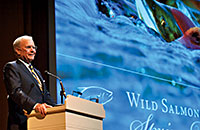
In early May, over 300 attendees gathered in downtown Portland for the first international conference on the topic of ecological interactions between wild and hatchery salmon. Tom Brokaw, the iconic American journalist and author, recognized the importance of the event in his eloquent address at the opening reception: "It is very heartening to look out across this room and see all the interests that are represented here geographically, politically, and otherwise, but with one great, common heart, and that is the common cause of the preservation of these magnificent species that swim in our oceans, come into our rivers, spawn, and that represent nothing less than the keystone species in this magnificent ecosystem that you all are privileged to live in."
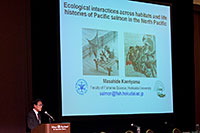
Interest in the topic of ecological risks to wild salmon from hatchery operations has been growing dramatically over recent decades — particularly in the U.S. Pacific Northwest where hatchery development has been intense as a result of significant habitat degradation and loss. Field research has begun to explore and systematically describe interactions between wild and hatchery fish. Our goal for the event was to channel this rising concern into frank discussion about what we know, what we don’t know, and how we might manage ecological risk now and in the future to conserve wild salmon.
"…understanding the current state of the science… will help me to look at where I might make changes in the future to the programs I oversee."
A hallmark of SoS conferences is to bring together leading research scientists to describe the state of our knowledge while also giving the stage to a variety of stakeholders. Attendees and presenters came from across the North Pacific, including delegations from Russia and Japan. Together, we addressed big themes including climate change, competitive interactions between salmon stocks in the ocean, critical gaps in our knowledge, and immediate needs for management actions to reduce risks from hatcheries. Climate change, in particular, generated much dialogue as presenters introduced it alternatively as the "dark umbrella", the "game changer", and a "great wave rising."
"The combination of research scientists, fishery managers and hatchery operators was highly informative"
A survey of attendees revealed that the conference met our expectation, with a number of attendees stating that they came away with a "broader appreciation for the co-evolution of human and hatchery systems … and how issues are changing with respect to … carrying capacity, climate change and our global economy." And many highlighted the value of hearing diverse and impassioned voices. Dr. Jack Stanford, in his opening night presentation, made a provocative challenge to identify cases that clearly show that hatcheries have benefited wild salmon. Whereas Jim Martin and Paul Lumley each clearly stated that hatcheries are indispensable in meeting trust obligations to tribes and buoying regional fishing communities, particularly in the Columbia River Basin. The conference closed with admonishments from Mr. Martin on the importance of being prepared for surprises, as human population increases and the climate changes. And, in his closing address, Dr. Roy Stein enjoined attendees to look to the north where habitat is still intact and wild salmon are still productive: "It may be that these hatcheries are counter-productive. In these systems, we still have a choice. With these hatcheries, I worry, we are sometimes doing more harm than good."
Proceedings from the conference, in the form of a special issue of the journal Environmental Biology of Fishes, were published in May 2012. See findings and review abstracts.
» Photographs by Samuel M. Beebe and Jamie Bosworth