
TAIMEN WORKSHOP
December 9–10, 2011 • Auckland, New Zealand
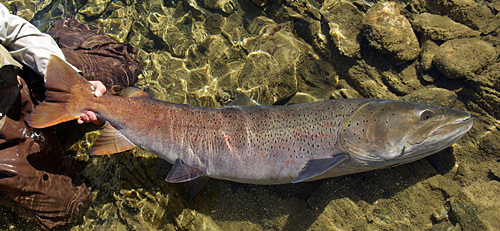
Conserving the largest salmon in the world: Challenges and opportunities to protect taimen as threats escalate throughout northern Eurasia.
Taimen (Hucho and Parahucho spp.) are coldwater salmonids found throughout Eurasia. Taimen are the largest salmonids in the world, reaching lengths of 2 m and living over 30 years of age. These fishes are under increasing threat from overfishing, poaching, habitat loss, and climate change.
State of the Salmon convened a productive and successful workshop as part of the annual meeting of the Society for Conservation Biology. For the first time, a group of scientists, conservationists and key stakeholders working on all species of taimen came together to present and discuss what is known about these unusual, mysterious and increasingly threatened fishes. There were nearly 20 experts from around the world, including representatives from many of the range states, including Russia, Japan, Austria, and Mongolia. Although Chinese representatives were unable to attend the workshop, we have established an active collaboration with several scientists working on these species in China. There were 12 presentations over two days (including one very informative presentation via the web by Misha Skopets, live from Khabarovsk, Russia!), followed by productive discussion.
Key highlights from the meeting
- Important new information was shared about the biology and status of these fishes. We made good progress on reaching consensus on the current conservation status of each species. It was clear from our discussions that all the species are under increasing threat. Draft assessments will be completed this spring, and we intend to have our results be included in a fall update of the IUCN Red List of Threatened Species. The five species we focused on in the workshop are:
- Korean taimen (Hucho ishikiwae)
- Sichuan taimen (Hucho bleekeri)
- Sakhalin taimen (Parahucho perryi)
- Danube salmon (Hucho hucho)
- Siberian taimen (Hucho taimen)
- Much of the deliberations focused on the range-wide status of Siberian taimen. Although the range of this species is enormous (from the Urals to the Lower Amur across a broad swath of Asia), the decline in range and abundance has been dramatic and troubling. This species is a key ecosystem indicator in some of our priority watersheds in the Russian Far East (including Langry River on Sakhalin and Tugur River in Khabarovsk).
- Workshop attendees agreed to work together on a multi-authored, synthesis publication, summarizing the biology, status, and needed conservation actions to protect these species. We hope to complete this manuscript in late 2012. This will help raise the profile of these species and emphasize the need for immediate conservation action.
- Our key Russian science partner, Lev Zhivotovsky, gave a very important presentation, introducing the concept of genetically-defined “conservation units” for Sakhalin taimen in the Russian Far East. In his presentation he advanced the idea of identifying and protecting populations in each region as a means to protect and conserve the species as a whole. This is an important milestone, and represents a new, scientifically-grounded conservation approach that follows on work that led to the establishment of Pacific salmon Evolutionarily Significant Units in the US and Pacific salmon Conservation Units in Canada. This will help guide our future research and conservation work on Sakhalin taimen.
Thanks to all for making this important event happen, particularly our workshop sponsors (Chester Zoo, Mohammed bin Zayed Conservation Fund, Ocean Park Conservation Fund Hong Kong, USFWS Wildlife Without Borders, Oji Paper, Sweetwater Travel, Taiwan Forestry Bureau, FISHBIO) and in-kind support from a number of agencies, businesses and universities.
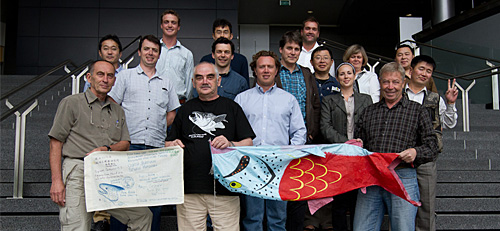
Pictured (from L to R): Anatoly Semenchenko, Kouichi Osanai, Andy Parkinson, Dan Bailey, Sergei Zolotukhin, Pete Rand, Michio Fukushima, Olaf Jensen, Steve Weiss, Zeb Hogan, Jin-Chwan Gwo, Harmony Patricio, Anneta Vyssotskaia, Lev Zhivotovsky, Tsogtsaikhan Purev and Gankhuyag Balbar (not pictured, Mihael Blikshteyn).