
SALMON in a CHANGING CLIMATE
Practical management options for an era of environmental change
November 15–17, 2011 • Hilton Hotel • Portland, Oregon
Going beyond salmon: Creating value for all
“We may be having a public value failure.” – Dr. Murray Rudd, University of York
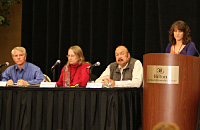
The workshop emphasized practical management responses and the need to go beyond the science, because as co-chair Erica Fleishman succinctly stated: “Everything we do in management reflects human values”. The keynote speaker, Murray Rudd, explained how threats to quality of life resulting from climate change can spur policy, regulation and action. People have to be concerned about climate change, and about salmon. Salmon are not taken for granted by the Tribes and First Nations, who “can’t have a culture without the resource” (Kit Rawson, Tulalip Tribes). Elsewhere, it varies: Alaskan participants commented that an overwhelming majority of Alaskans polled in different recent surveys affirmed that salmon are vital to their way of life, whereas in the Okanagan Basin, a panelist described the challenge of building a sense of pride and community interest in the salmon in a watershed with diminished returns.
Impacts of ocean acidification
"Ocean acidification impacts are already being felt and will have increasingly dramatic impacts on marine ecosystems in the future." - Dr. Christopher Sabine, NOAA Pacific Marine Environmental Laboratory
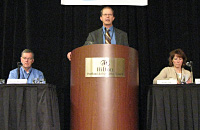
The keynote address was followed with presentations on the latest science regarding climate related environmental impacts. In the marine environment, Dr. Christopher Sabine presented evidence that ocean acidification resulting from the absorption of carbon from the atmosphere has increased 30% over the last 200 years and is putting food webs in the North Pacific at risk, creating considerable uncertainty for the future of salmon and other species. However, due to the lack of biological and geochemical observations in the ocean it will be extremely difficult to manage for changes we don't fully understand.
For freshwater environments, current predictions are that salmon in the southern part of their range will be put at risk by higher water temperatures and lower flows. In the north, salmon may expand their range, but changes in timing of peak flows will put pressure on salmon to adapt, with uncertain consequences.
Adaption strategies: Salmon genetic and life history diversity is key
“Give the fish a chance to adapt.” - Abby Hook, Tulalip Tribes
"If you reduce the diversity in salmon stocks (i.e. overfishing and hatchery production), you reduce the capacity for adaptation, and you increase the probability of quasi-extinction." - Dr. Daniel Schindler, University of Washington
Salmon landscapes are shifting mosaics of suitable habitat that will vary from place to place and year to year based on factors like rainfall and snowmelt, affected by changes in regional climate. Given the scope and magnitude of these changes, Dr. Daniel Schindler presented evidence that maintaining salmon genetic and life history diversity, along with habitat complexity, is critically important to protecting fisheries and the people that rely on them. For example, he showed how losing diversity results in more frequent fishery closures, even if the average return stays the same.
The good news is that adaptation can be encouraged without perfect science. We can talk about variability and uncertainty without letting it be a barrier to action, and the case studies clearly demonstrated this “act now” approach. In the Snohomish and Okanagan basins, participants described their work to move beyond isolated restoration projects toward building a package of actions that complement each other and can maintain a diversity of healthy fish habitat on a scale that matters when considering climate change. In the Tongass National Forest in Alaska, managers are keeping the pressure off weaker runs by shifting fishing pressure to river systems showing robust returns. All these practical management actions help support the diversity and resilience that will help see salmon through climate change. The theme of protecting diversity to mitigate climate impacts and manage risk was reinforced throughout the conference.
We’re all in this together
“The idea of collaboration as a way to work together isn’t new but it is definitely taking over in terms of how you get things done.” - Anna Warwick Sears, Okanagan Basin Water Board"
The spirit of the conference might be best summarized as ’we’re all in this together.’ “Our best chance is to leverage each other’s talents and resources and work together” (Guido Rahr, Wild Salmon Center). Janne Kaje of King County, Washington, commented that even if some regions stand to lose more from climate change than others, collaboration is not optional, particularly to engage those whose actions have to synchronize for management measures to take effect, with continued engagement to monitor and adapt over time. Debbie Terwilleger ( Snohomish County, Washington) reinforced this, saying that while at first collaboration can be difficult, it might help to imagine conversations had while sharing a car ride, all heading in the same direction.
All three case studies demonstrated effective ways of working together. For example, the Snohomish Basin Salmon Recovery Forum, which has 41 members including 14 jurisdictions, the Tulalip Tribes and 11 interest groups, is an example of an engaged watershed working well together. These new collaborations encompass more parts of the systems affecting salmon and build mutually respecting and trusting relationships. While it can take a crisis to bring people together, other forces are needed to sustain the effort, from a focus on shared priorities, through incentives to encourage engagement, to computer-based tools for balancing multiple objectives.
Getting the message out: providing science and solutions
“You scientists have to get it out there.” - Neyssa Hays, Oregon State University student"
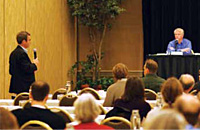
During the closing session, participants emphasized getting the message out as a key action they wish to take, sparked by the workshop. The idea is to entice people to do the right thing and support necessary management actions through messaging, incentives, clear information and the opportunity to dialogue. In different words, they were echoing the imperative set early in the conference by Murray Rudd, to remedy the current “public value failure.”
Increasingly, scientists can’t just leave the data on the table for society – they have to be part of the discussion as one panelist commented. The messages themselves have to provide grounds for hope and guidance for solutions, rather than just ringing alarm bells. Part of the message is that we do have choices and are not locked into a predetermined future. One choice we have to make is to reduce carbon emissions. That’s a tough one for society but it is a message that has to get out because the food webs of the North Pacific are at risk.
» Photographs by Wild Salmon Center